

For years, trainers repeated the familiar advice: keep your knees from drifting past your toes when you squat. The idea spread quickly through gyms, shared between coaches and athletes, even though few people explained why it mattered. But newer biomechanics studies show that this old belief doesn’t hold up the way people once thought.
Today, most experienced trainers and sports health experts emphasize natural movement and balanced loading instead of forcing everyone to follow a rigid rule about where the knees should land during a squat.
Should Your Knees Pass Your Toes When You Squat?
Human anatomy reveals that when climbing stairs, getting into a car, or sitting down, the knee naturally slides past the toes. These natural actions rely on a forward knee glide, and the body is built for it.
During squats, letting your knees shift forward helps you stay balanced, especially if you have long legs or use a closer stance. It also stops your upper body from tipping too far forward, which takes pressure off your lower back. For a lot of people, a comfortable and stable squat naturally brings the knees a bit past the toes.
Modern biomechanics backs up this kind of movement as normal and safe. As long as your heels stay planted and you move with control, letting your knees pass your toes is not only safe, it often helps you squat more smoothly.
Do Knees Passing Toes Increase Injury Risk? What Research Really Shows?
People started worrying about knees passing the toes because older studies looked at how much pressure the knee handled during a deep squat. Early data shows that the knee took on more strain when it moved forward in the squat. So trainers started telling everyone to keep their knees tucked back to avoid that added pressure.
However, later research made it clear that restricting the knees from moving forward simply transfers stress elsewhere, mainly to the hips and spine. In short, the stress doesn’t disappear; it moves.
A landmark study published in the Journal of Strength and Conditioning Research demonstrated that preventing knee travel reduced knee torque but dramatically increased hip torque.
For many people, especially those with limited hip mobility or weak core control, that shift can actually increase the risk of discomfort or injury.
Essential Squat Tips to Protect Your Knees and Improve Form
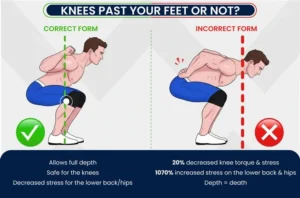
Before diving into the specifics, it’s important to understand that safe squatting isn’t just about how far your knees move; it’s about balance and proper muscle engagement.
Here are some of the key tips to keep in mind when squatting to stay safe and squat effectively:
-
- Proper Foot Stability
Keeping your foot firmly planted on the heel and both sides of the toes helps your knee move naturally and stay stable during squats. If your foot rolls inward, the knee can bend the wrong way, which puts it at higher risk of injury. - Strong Quadriceps and Hip Muscles
Your quads help control how far the knees move forward, while your glutes and hamstrings keep everything lined up. Strong muscles make sure your knees bend naturally and safely as you squat. - Controlled Depth Based on Mobility
Everyone has a different squat depth, and that’s completely normal. How flexible your ankles are makes a big difference in how deep you can safely go. If your ankles are flexible, your knees can move forward without your heels coming off the ground, keeping the movement safe. - Consistent Technique
Research supports that how you squat matters more than how far your knees move. Going down slowly, keeping your knees aligned, and staying upright takes pressure off your joints and makes the squat safer and more effective.
- Proper Foot Stability
Knee-Over-Toe Squat Safety: Evidence from Recent Research
Evidence shows that letting your knees pass your toes during a squat can be safe and even helpful when done correctly.
A scoping review published in Frontiers in Sports and Active Living looked at 15 studies on resistance-trained individuals and found that 14 of them reported no negative effects on knee joint health from deep squats, as long as proper technique was used.
Supporting this, a 2024 biomechanical study by Straub and Powers highlighted that forward knee movement can actually help distribute loads more evenly across the hip and knee, depending on your stance, trunk position, and tibia angle.
In fact, an earlier classic experiment showed that when participants were prevented from letting their knees move forward, hip torque increased dramatically, suggesting that a little forward knee travel may be necessary for safe joint loading.
Taken together, these findings make it clear that letting your knees move slightly past your toes isn’t inherently harmful. However, fitness professionals trained in physical medicine and rehabilitation sports medicine can guide you through proper squat technique, helping you correct imbalances and safely progress your load over time.
Final Thoughts on Knee-Over-Toe Squat Safety
As shown throughout this blog that knee-over-toe squats are safe when done properly. Paying attention to foot placement, muscle strength, and controlled depth can help prevent injury and improve performance. For personalized guidance and supervision, working with professionals at physical therapy Pasadena California ensures proper squat mechanics, corrects imbalances, and supports safe progression.
Incorporating these practices allows knee-over-toe squats to be an effective and natural way to build strength.